
The Wordlize Manifesto
Vocabulary Is Human
We believe vocabulary is not just a test-prep skill. It is a human one.
We believe the limits of a student’s language are the limits of their world.
We believe vocabulary is a path to better reading.
We believe the best way to learn vocabulary is by encountering words in context.
We believe the key to understanding words is context, not definition.
We believe truly knowing words comes through repeated exposure, not memorization.
We believe games can serve learning.
We believe the best learning method is useless if it is abandoned.
We believe in looking to the latest research to refine our methods.
We believe every learner deserves to know the words that will expand their world.
“The limits of my language mean the limits of my world.” — Ludwig Wittgenstein, 1922.1
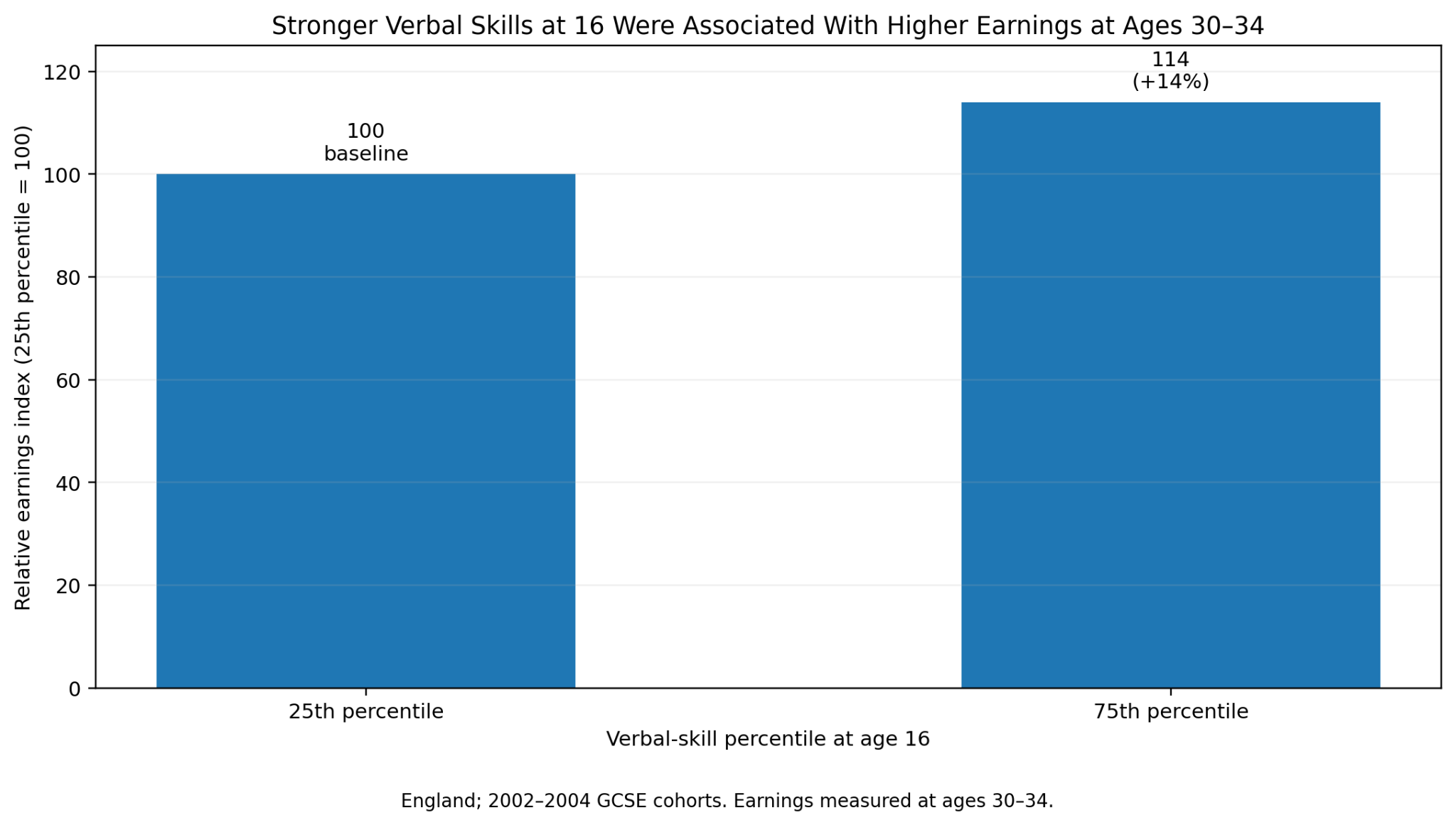
We are all born with no words. Over time, we acquire thousands upon thousands of them, and with each new vocabulary, the world becomes more precise. Words are what let us name dog and tree, describe what is rough or fragile, distinguish skimming from scrutinizing and irritation from indignation, weigh what is plausible against what is probable, and eventually grasp distinctions between authority and legitimacy, ambiguity and equivocation, determinism and fatalism, justice and retribution. Vocabulary, according to E. D. Hirsch, is like an index of what we have learned about the world, and it has far reaching and wide consequences.2 In longitudinal studies, differences in early childhood vocabulary size are correlated with higher reading and mathematics achievement years later, and differences can be detected as early as toddlerhood.34 Vocabulary ability is also associated with college completion and earnings afterwards.25
But our vocabulary goes beyond just having measurable practical effects on our education or lives, it affects how we think about our world. Words and verbal labels have been shown to influence categorization, attention, visual discrimination, and even aspects of perception.6 Vocabulary both expands the limits of our world and gives us a more precise way of seeing it.
The Vocabulary Crisis and Its Consequences
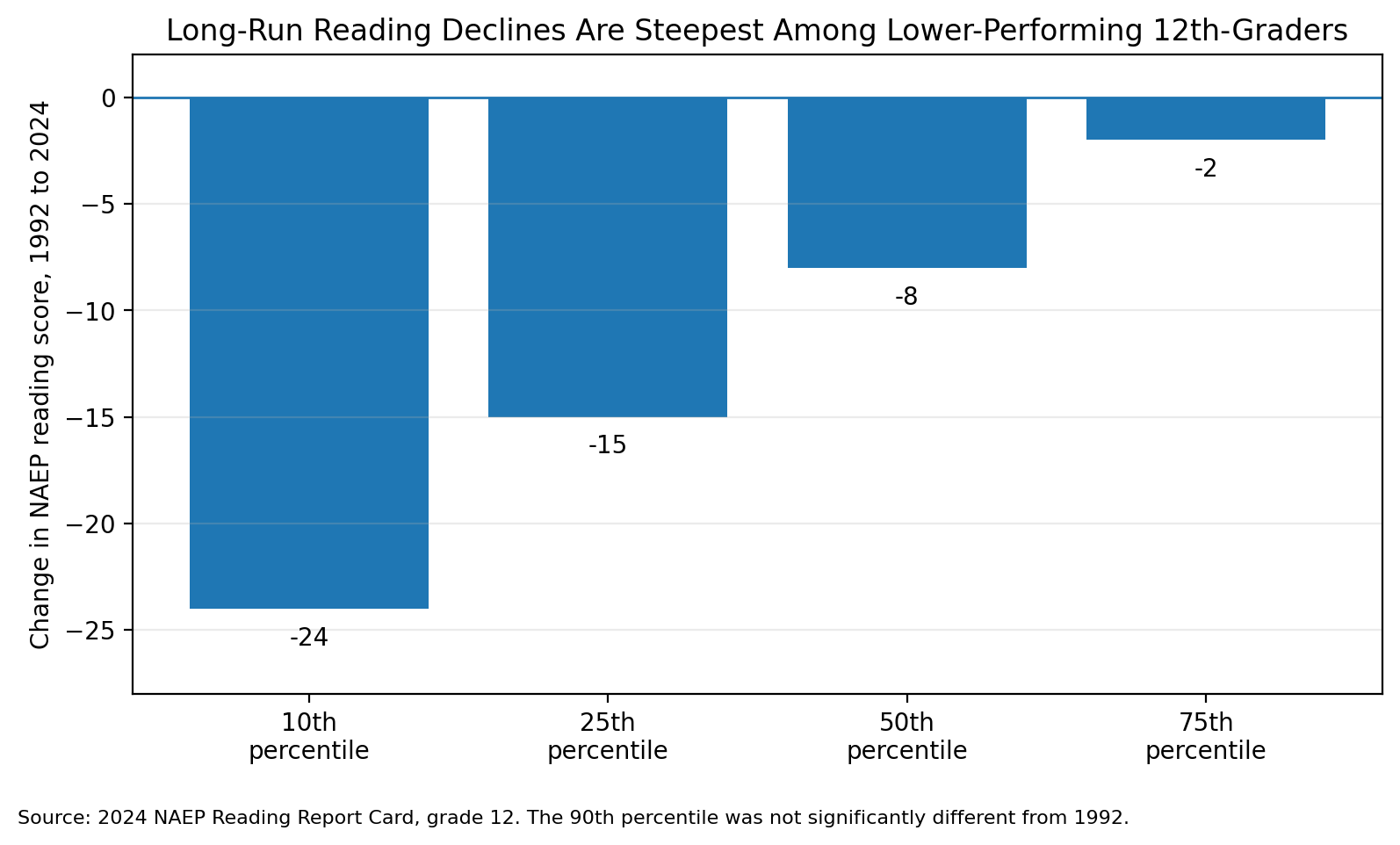
Unfortunately despite its importance, vocabulary is on the decline. On the 2024 Nation’s Report Card, average reading scores in the United States for both fourth- and eighth-graders had decreased five points from the 2019 report. 40 percent of fourth-graders and 33 percent of eighth-graders scored below the NAEP Basic level.7 By twelfth grade, the decline is even starker. The average reading score in 2024 was three points below the average in 2019 and ten points below scores in 1992. The decreases are especially severe among struggling readers. From 1992, scores fell 24 points at the 10th percentile and 15 points at the 25th, while the higher performing students at the 75th percentile showed small decline of 2 points.8 The newest long-term data also shows thirteen-year-olds’ reading scores remain below 2020 and 2012 levels and, on this long-running assessment, are now statistically indistinguishable from those of thirteen-year-olds in 1971.9
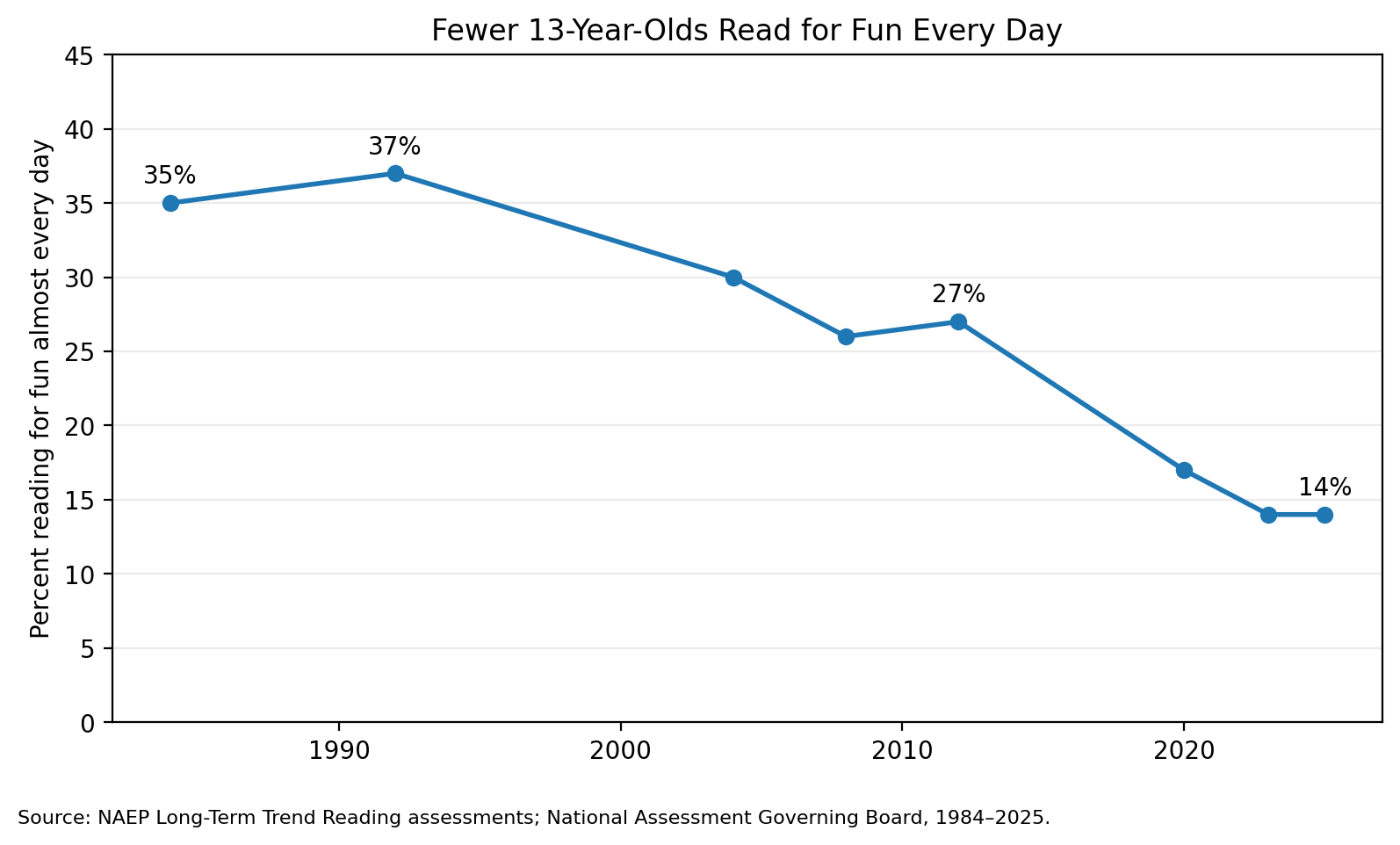
At the same time, we are simply reading less as a society. In 1984, 53 percent of nine-year-olds and 35 percent of thirteen-year-olds said they read for fun almost every day. The rates have dropped almost consistently for the next four decades. Those numbers had fallen to 37 percent and just 14 percent by 2025.9 This is a troubling trend as reading is an important way we acquire vocabulary. There is evidence that vocabulary may be directly in decline as well. In a study of US adults from 1974 to 2016, vocabulary scores declined within every level of educational attainment, with the largest drop among college graduates.10 And as a growing vocabulary is necessary to unlock reading, the declines form a negative feedback loop.
How We Humans Actually Learn Words
“preliterate children … must be lexical vacuum cleaners, inhaling a new word every two waking hours, day in, day out.” — Steven Pinker, The Language Instinct, Chapter 5, “Words, Words, Words,”
In The Language Instinct, Steven Pinker showed that we learn language more through exposure and usage, not so much through instruction. He writes “Language develops in the child spontaneously, without conscious effort or formal instruction.”11 But spontaneous does not mean without experience. Language develops through interaction. Adults talk to children, respond to their sounds, tell stories, sing songs, answer questions, and read books. Research has found that both the amount and the richness of this language are associated with later vocabulary development.12
The key difference is between formal learning and learning by use. A child learns three things, a noun, a verb, and syntax, before he/she can identify any of these terms. And the language children are exposed to is not of all equal quality. One hundred picture books were compared to ordinary child directed speech, and there were significantly more lexical diversities in the picture books than in the ordinary child directed speech.13 Reading expands the vocabulary and constructions that may not be offered by everyday speech.
The human capacity for language may be instinctive, but the words themselves plainly are not. A newborn’s brain is not hardwired to associate the word dog with a four-legged furry animal, and indeed, for a French child, the word dog would be meaningless. These connections have to be picked up from the language around us. Pinker jokingly calls young children “lexical vacuum cleaners,”11 absorbing words at a rate that would be astonishing if we thought of each one as a deliberate act of memorization. Current estimates suggest that by age twenty, the average native speaker of American English recognizes roughly 42,000 words, plus thousands of idioms and other fixed expressions, but there can be enormous differences between individuals depending in part on their education and language exposure.14
The number of words that we acquire gives us an indication of what the process of vocabulary growth should be like. Nagy and Anderson concludes that systematic direct instruction can account for only a modest fraction of all the words students will eventually know.15 We must learn most words in other ways. When researchers have studied how students learn new words, they have found that vocabulary learning happens across the curriculum, even when there’s no explicit vocabulary lesson. In one classic experiment, third-, fifth-, and seventh-graders read ordinary narrative and expository passages that contained unfamiliar words. When they were tested six days later, they knew measurably more about those unfamiliar words just from the context of their reading.16 Across twenty experiments, students gained measurable knowledge of about 15 percent of the unfamiliar words they encountered through normal reading alone.17 More recent experiments with children likewise show word knowledge developing incidentally as they read, encounter a word again, and gradually become faster and more certain in processing it.18 This is how we humans acquire our vocabulary through repeated encounters and exposures.
None of this means that vocabulary should never be taught. Quite the opposite. Explicit instruction can accelerate learning, clarify a meaning that context leaves ambiguous, and direct attention toward words a learner might otherwise miss.19 The National Reading Panel’s review concluded that vocabulary develops through both direct and indirect learning, and emphasized rich contexts, repeated exposure, and multiple encounters rather than reliance on any single method.20 An earlier meta-analysis similarly found that the most effective vocabulary instruction combined definitions with contextual information, deeper processing, and more than one or two exposures to a word.21 The lesson is not that instruction is unnecessary. It is that good instruction works with the way humans already acquire words, rather than pretending a definition on a list is the finished product.
We do not ordinarily build a vocabulary by memorizing a dictionary. We build it encounter by encounter. A word appears in something someone says. Then in a story. Then in a different sentence where its meaning shifts slightly. Each meeting adds something until, eventually, the word no longer feels learned at all. It truly becomes part of our vocabulary.
Wordlize: the Engineered Encounter
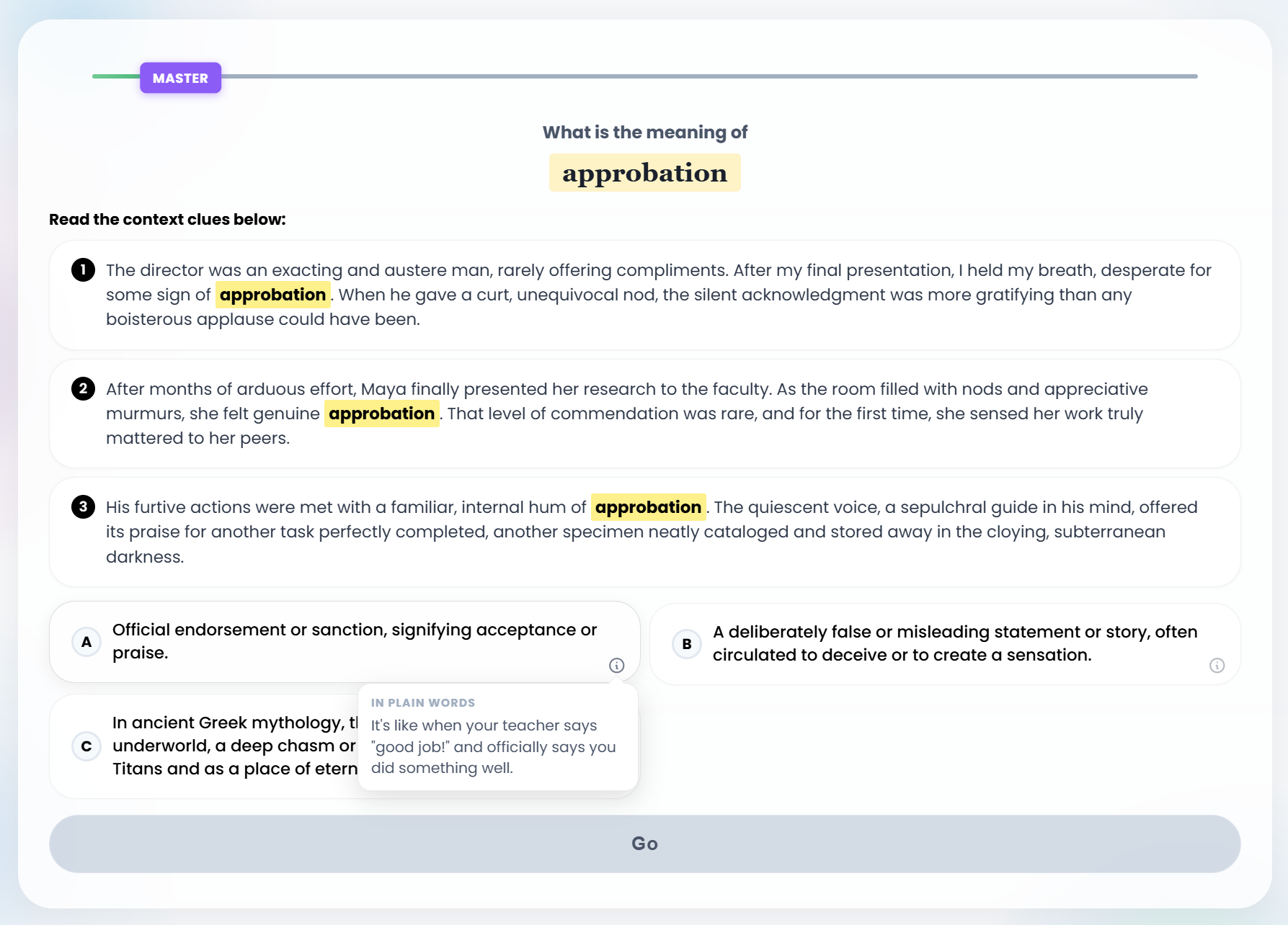
Wordlize follows the principles of how we humans learn vocabulary. If vocabulary is built through repeated encounters, and a mix of instruction and clarification, then Wordlize can make those encounters happen at the right moments with an engineered context. A new word is not introduced as a word and definition pair with an example as most current vocabulary solutions do. Instead, the learner first meets the word in several different contexts and has to infer what it means. In the example above, approbation is desired, felt, and then shown by an inner voice. Each sentence reveals the word from a slightly different angle. The learner is not told what approbation means. The learner goes through the instinctual process of initial exposure and then the neural connections form as one figures out its meaning.
The engineered encounters to the word go beyond the first exposure. Wordlize returns to the targeted words later in new passages, questions, and games, requiring the learner to recognize or retrieve their meaning again and again. Research very clearly shows that repeated exposure matters. The experiments very consistently show that multiple encounters, varied contexts, and active engagement rather than one-time presentation leads to true vocabulary building.182021 Wordlize takes what happens naturally over months or years of wide reading and makes part of that process intentional and focused. Encounter a word, work out its meaning, meet it somewhere different, nearly forget it, retrieve it again.
The goal of Wordlize is not to have another tool that simulates a dictionary or flash cards more efficiently. It is to create encounters holistically and in the way we learn vocabulary. Provide enough context to give a word inferrable meaning, enough variation to give that meaning depth, and enough well-timed returns for the word to stop feeling like something learned and start feeling like something known — to truly count the word in one’s vocabulary.
Remembering Requires Returning
Encountering a word is only the beginning. We as humans naturally forget things. One of the most reliable findings in learning science is that when we return matters. Information studied in several sessions separated over time is generally retained better than the same practice compressed into one sitting. A major review of the spacing effect examined 839 assessments across 317 experiments and found a robust advantage for distributed practice over massed repetition.22 Just as importantly, there is no single perfect interval: research following learners for as long as a year found that the spacing that works best grows with how long we hope to remember something.23 Durable memory is built not by repeating something again immediately, but by letting some time pass and then asking the mind to find it again.
Vocabulary follows the same pattern. In experiments that included foreign-word learning, appropriately spaced reviews produced dramatically better long-term recall than poorly timed repetitions, with the advantage persisting across delays measured in months.24 A 2023 vocabulary study likewise found that learners who practiced words across separate days retained them better two weeks later than learners who completed the same kind of practice in a single massed session.25 And the effect is not confined to tightly controlled laboratory experiments. A recent meta-analysis of classroom studies involving more than three thousand learners found a moderate overall advantage for distributed practice over massed practice.26 Spacing creates a useful difficulty. When a word has begun to fade, remembering it requires more effort, and successfully reconstructing that memory helps make the next retrieval easier.
Wordlize builds that cycle into the life of every word. A word begins in Introduction, where the learner first encounters its meaning through context and works with it while it is still new. It then moves into Review: the word returns after time has passed, often through a different question, game, or context, so the learner has to recover what they previously understood rather than simply recognize something they saw moments ago. Finally comes Master, where the learner must demonstrate that the word has survived those repeated encounters and can still be understood when it appears in unfamiliar contexts. At each stage, spaced repetition principles are followed. Wordlize turns forgetting from a failure into part of the schedule.
The student masters a word not by answering a question correctly once, but by repeatedly retrieving its meaning until it becomes part of their vocabulary.
The Most Powerful Learning System Is Useless If Nobody Uses It
A learning system can be perfectly designed on paper and still fail for a simple reason: students stop using it. That is where gamification matters. Across educational settings, meta-analyses find that gamified learning produces positive average effects not only on motivation and participation, but on learning itself. One major meta-analysis found significant gains in cognitive, motivational, and behavioral outcomes, with the cognitive effect approaching half a standard deviation.27 Another review of thirty gamified interventions involving more than 3,200 learners found a similar medium-sized improvement in academic performance.28 The evidence is not uniform, and points or badges do not magically make bad instruction good. What matters is whether the game changes the behaviors that lead to learning — encouraging students to attempt another problem, respond to feedback, practice again, and come back the next day.
That motivation becomes particularly important in vocabulary, where repetition is necessary but can also become monotonous. A 2025 systematic review by Dirac Ge examined thirty peer-reviewed studies of gamification and vocabulary learning published between 2014 and 2024, focusing primarily on students ages 13 to 18.29 It found that competitive elements such as rankings and leaderboards can increase engagement and effort, though too much competition can also create anxiety. Cooperative mechanics tend to appeal more broadly and encourage consistent participation. But one of the clearest themes was simpler: gamification can make repetition feel like progress. Repeated vocabulary practice became more engaging when paired with milestones, feedback, varied activities, and adaptive progression. A separate meta-analysis of digital game-based vocabulary learning likewise found a moderately large overall advantage for game-based approaches over nongame instruction.30
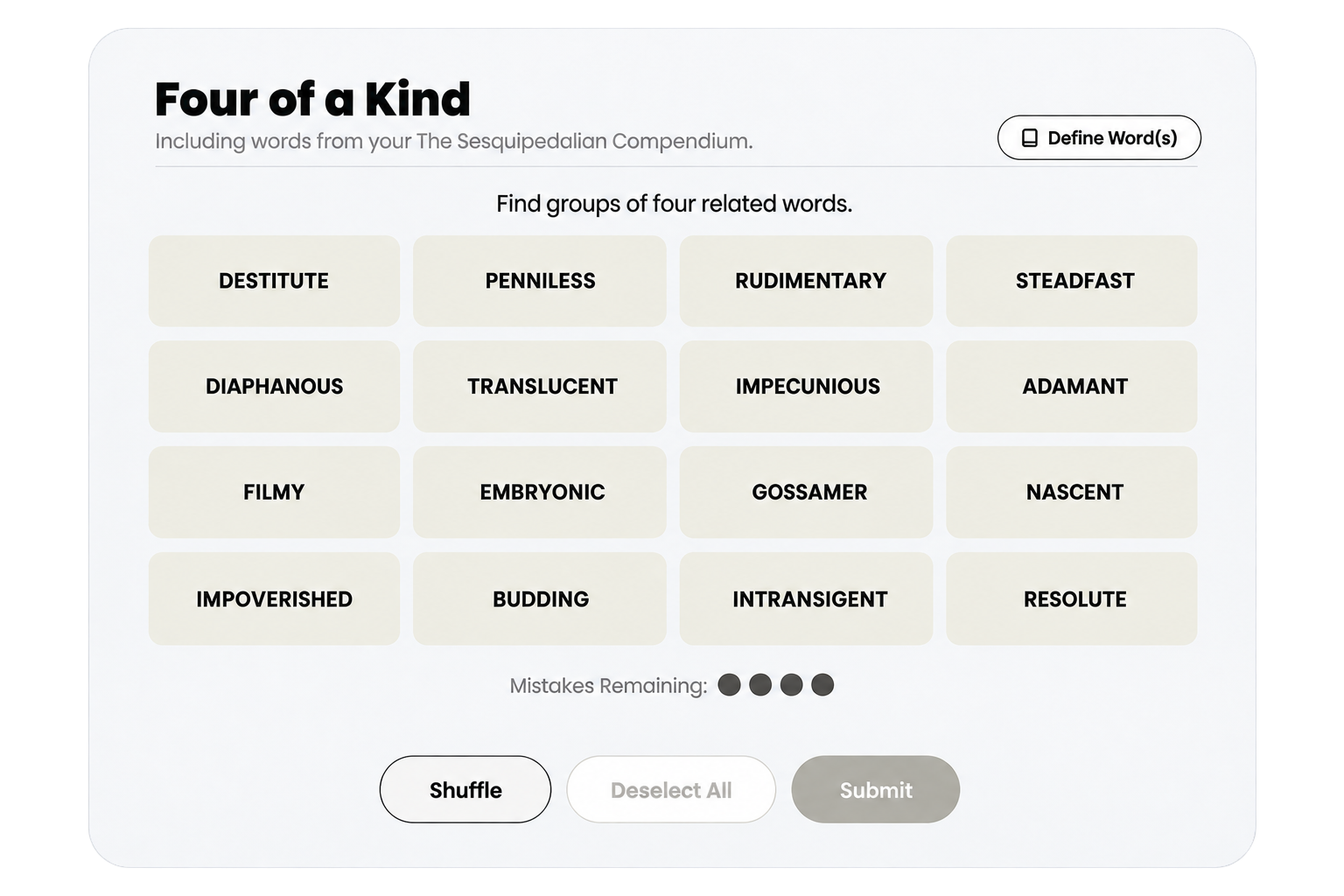
Wordlize is designed around the principle that games should reinforce the behaviors that lead to learning, not merely decorate practice with points and badges. Four of a Kind, Word Feud, and other games give learners different reasons and different ways to recognize, retrieve, and work with the same words. Leaderboards introduce friendly competition and a social motivation to return. But the games themselves are not the center of the learning system. The center is the Daily Quest: one short, finite session that brings together new introductions, scheduled reviews, mastery attempts, and games. A learner does not need to remember which words are beginning to fade or decide what to practice next. Wordlize schedules those encounters and turns them into visible daily progress.
That is what gamification is for. Context gives a word meaning. Repeated encounters deepen understanding of that meaning. Spacing keeps the meaning from disappearing. The Daily Quest and the various games provide a reason to complete the cycle each day.
Wordlize Is Not Better Than Reading
Wordlize is not better than reading. Nor is it supposed to be. Wide, sustained reading surrounds words with something no vocabulary app can fully reproduce: stories, arguments, knowledge, syntax, emotion, and the unpredictable collision of ideas. It is also one of the great engines of vocabulary growth. Children measurably learn unfamiliar words simply by encountering them in ordinary reading,16 and across studies, those small incidental gains accumulate over repeated encounters.17 A student who becomes an avid reader eventually has millions of opportunities to meet language in the wild.
The problem is getting there. As we saw earlier, reading becomes dramatically harder when too much of the language is unfamiliar.313233 A student who is already struggling with a text will just be frustrated by being told to “read more.” Although reading builds vocabulary, vocabulary is also part of what makes reading possible. Wordlize is designed to help break that frustrating cycle. It deliberately supplies struggling readers with the encounters, context, retrieval, and repetition that a proficient reader would accumulate naturally, with the goal of lowering the barrier to increasingly difficult texts. The destination is not more time inside Wordlize. The destination is reading. Vocabulary is the on-ramp.
The distinction between mere word recognition and proficient reading informs the design of Wordlize. In Artful Design, Stanford professor and technologist Ge Wang begins with the maxim, “What we make, makes us.”34 His broader argument is that technology should not be designed only around what it can accomplish functionally, but around the human values and purposes those functions are meant to serve.34 Wordlize was designed with that principle in mind. A streak, a leaderboard, an algorithm, or a perfectly timed review can be useful, but none of those is the end goal of the game. They are the means toward something more human: expanding the limits of a learner’s world.
The best outcome for Wordlize is therefore a strange one for a software product: that a learner eventually needs to use it less. Vocabulary begins to compound. Reading becomes easier, so the learner reads more. Reading more creates still more encounters with words and knowledge. Those encounters make the next text easier still.216 Wordlize has done its job when encounters in the world outside the app begin replacing the engineered encounters in the game.
Wordlize does not exist to replace reading. It exists to unlock it.
Vocabulary Is Human
We begin life with almost no language. Then, word by word, the world comes into focus. We learn to name what we can touch, then what we can feel, then what we can only imagine. Eventually, language lets us reach beyond our own lives.
That is why vocabulary matters. Not because knowing more words makes someone sound more intelligent. Not because a test rewards them. But because every word understood makes something else easier to understand. A sentence opens. Then a page. Then a book. An idea that once seemed distant becomes thinkable. A distinction that once went unnoticed becomes visible. The limits move.
“Books permit us to interrogate the past with high accuracy; to tap the wisdom of our species; to understand the point of view of others.” — Carl Sagan in The Demon-Haunted World
And those limits should be able to move for everyone. No person should be locked out of a book simply because it contains too many words they have not yet had the chance to learn. No learner should have to depend entirely on the accident of having grown up surrounded by the right books, the right conversations, or the right opportunities. Technology cannot replace those things. But it can help more people access the benefits of a language-rich environment.
That is what we want Wordlize to do. Not keep learners inside an app, but give them enough words to leave it behind. To make the next book easier than the last. To turn unfamiliar language into familiar language, and familiar language into a larger world.
We inherit words from those who came before us. We use them to understand one another while we are here. And, someday, we will leave our own words behind.
Vocabulary is not just something humans learn. Vocabulary is human.
Notes & Sources
-
Ludwig Wittgenstein. Tractatus Logico-Philosophicus, proposition 5.6 (1922): “The limits of my language mean the limits of my world.” https://www.wittgensteinproject.org/w/index.php/Tractatus_Logico-Philosophicus_%28English%29 ↩
-
E. D. Hirsch, Jr. “A Wealth of Words.” City Journal, Winter 2013. Hirsch discusses vocabulary as an index or proxy of accumulated knowledge, and connects verbal ability and vocabulary with educational attainment, college completion, income, the Matthew Effect, and knowledge acquisition. https://www.city-journal.org/article/a-wealth-of-words ↩ ↩2 ↩3
-
Dorthe Bleses, Guido Makransky, Philip S. Dale, Anders Højen, and Burcak Aktürk Ari. “Early Productive Vocabulary Predicts Academic Achievement 10 Years Later.” Applied Psycholinguistics 37, no. 6 (2016): 1461–1476. A longitudinal study of 2,120 children found that expressive vocabulary measured at 16–30 months predicted sixth-grade reading and mathematics outcomes roughly a decade later. https://doi.org/10.1017/S0142716416000060 ↩
-
Paul L. Morgan, George Farkas, Marianne M. Hillemeier, Carol Scheffner Hammer, and Steve Maczuga. “24-Month-Old Children with Larger Oral Vocabularies Display Greater Academic and Behavioral Functioning at Kindergarten Entry.” Child Development 86, no. 5 (2015): 1351–1370. A population-based longitudinal study of 8,650 U.S. children found that larger oral vocabularies at age two predicted stronger reading and mathematics achievement at kindergarten entry, even after extensive covariate adjustment. https://doi.org/10.1111/cdev.12398 ↩
-
Judith M. Delaney and Paul J. Devereux. “The Math-Verbal Divide: Unequal Returns to Cognitive Skills in Education and Work.” IZA Discussion Paper No. 18542 / CEPR Discussion Paper, 2026. Using population-level administrative data from England, the study follows students from national examinations at age sixteen through higher education and employment into their thirties. Moving from the 25th to the 75th percentile of verbal skill at age sixteen was associated with roughly 14 percent higher earnings at ages thirty to thirty-four. Verbal skill is broader than vocabulary, so this source supports claims about verbal ability rather than causal claims about vocabulary itself. https://www.iza.org/publications/dp/18542/the-math-verbal-divide-unequal-returns-to-cognitive-skills-in-education-and-work ↩
-
Gary Lupyan. “Linguistically Modulated Perception and Cognition: The Label-Feedback Hypothesis.” Frontiers in Psychology 3 (2012): 54. Lupyan reviews experimental evidence that linguistic labels can influence processes often considered nonverbal, including categorization, visual discrimination, attention, memory, and detection of visual stimuli. He proposes that language can flexibly modulate ongoing cognitive and perceptual representations rather than merely attaching names to independently formed concepts. https://pmc.ncbi.nlm.nih.gov/articles/PMC3297074 ↩
-
National Center for Education Statistics. The Nation’s Report Card: 2024 Reading Assessment, Grades 4 and 8. U.S. Department of Education. In 2024, average reading scores at both grades 4 and 8 were five points below the scores for 2019; 40 percent of fourth-graders and 33 percent of eighth-graders performed below the NAEP Basic level. Note: NAEP Proficient is not equivalent to “grade level.” https://www.nationsreportcard.gov/reports/reading/2024/g4_8/ ↩
-
National Center for Education Statistics. The Nation’s Report Card: 2024 Reading Assessment, Grade 12. U.S. Department of Education. The 2024 average reading score was three points below the 2019 average and ten points below the 1992 average. Compared with 1992, scores were 24 points lower at the 10th percentile, 15 points lower at the 25th, 8 lower at the median, and 2 lower at the 75th, while the 90th percentile showed no statistically significant decline. https://www.nationsreportcard.gov/reports/reading/2024/g12/ ↩
-
National Assessment Governing Board / National Center for Education Statistics. 2025 NAEP Long-Term Trend Assessments in Reading and Mathematics, released June 10, 2026. Post-pandemic, nine-year-olds’ reading scores recovered to a level not significantly different from those of 2020, while thirteen-year-olds’ scores remained below those of 2020 and 2012. In 2025, 37 percent of nine-year-olds and 14 percent of thirteen-year-olds reported reading for fun almost every day, compared with 53 percent and 35 percent, respectively, in 1984. https://www.nationsreportcard.gov/ltt/2025/ ↩ ↩2
-
Jean M. Twenge, W. Keith Campbell, and Ryne A. Sherman. “Declines in Vocabulary Among American Adults Within Levels of Educational Attainment, 1974–2016.” Intelligence 76 (2019): 101377. Using vocabulary-test data from 29,912 participants in the nationally representative General Social Survey, the authors found declining vocabulary scores from the mid-1970s through the 2010s within every level of educational attainment, with the largest declines among college graduates. Overall population vocabulary scores remained relatively stable as average educational attainment increased. https://www.sciencedirect.com/science/article/abs/pii/S0160289618302198 ↩
-
Steven Pinker. The Language Instinct: How the Mind Creates Language. Originally published 1994; Harper Perennial Modern Classics edition, 2007. Pinker argues that human language develops largely without conscious effort or formal instruction. Chapter 5, “Words, Words, Words,” discusses lexical acquisition and describes young children as “lexical vacuum cleaners.” Pinker’s work is useful for the larger argument that language is acquired through exposure and use rather than primarily through explicit formal teaching. https://stevenpinker.com/publications/language-instinct-19942007 ↩ ↩2
-
Meredith L. Rowe. “A Longitudinal Investigation of the Role of Quantity and Quality of Child-Directed Speech in Vocabulary Development.” Child Development 83, no. 5 (2012): 1762–1774. In a longitudinal study of 50 parent-child dyads, both the quantity and quality of caregiver language predicted later vocabulary development, with diverse and sophisticated vocabulary explaining additional variation even after accounting for socioeconomic status and children’s earlier vocabulary. https://doi.org/10.1111/j.1467-8624.2012.01805.x ↩
-
Jessica L. Montag, Michael N. Jones, and Linda B. Smith. “The Words Children Hear: Picture Books and the Statistics for Language Learning.” Psychological Science 26, no. 9 (2015): 1489–1496. Comparing a corpus of 100 children’s picture books with matched child-directed speech, the authors found that picture books contained more unique word types and greater lexical diversity, suggesting that shared reading can expose children to vocabulary beyond ordinary conversation. https://doi.org/10.1177/0956797615594361 ↩
-
Marc Brysbaert, Michaël Stevens, Paweł Mandera, and Emmanuel Keuleers. “How Many Words Do We Know? Practical Estimates of Vocabulary Size Dependent on Word Definition, the Degree of Language Input and the Participant’s Age.” Frontiers in Psychology 7 (2016): 1116. The authors estimate that an average twenty-year-old native speaker of American English knows approximately 42,000 words, as well as roughly 4,200 idioms and other fixed expressions, with substantial differences associated with age, education, and language exposure. https://doi.org/10.3389/fpsyg.2016.01116 ↩
-
William E. Nagy and Richard C. Anderson. “How Many Words Are There in Printed School English?” Reading Research Quarterly 19, no. 3 (1984): 304–330. The authors estimate the enormous number of distinct word families encountered in printed school English and argue that systematic direct vocabulary instruction alone cannot account for more than a fraction of the vocabulary students ultimately acquire. https://doi.org/10.2307/747823 ↩
-
William E. Nagy, Richard C. Anderson, and Patricia A. Herman. “Learning Word Meanings from Context During Normal Reading.” American Educational Research Journal 24, no. 2 (1987): 237–270. In a study of 352 students in grades three, five, and seven, researchers found small but reliable gains in knowledge of unfamiliar words encountered during ordinary narrative and expository reading when measured six days later. https://doi.org/10.3102/00028312024002237 ↩ ↩2 ↩3
-
M. S. L. Swanborn and Kees de Glopper. “Incidental Word Learning While Reading: A Meta-Analysis.” Review of Educational Research 69, no. 3 (1999): 261–285. A meta-analysis of twenty experiments found that students acquired some knowledge of roughly 15 percent of unfamiliar words encountered during normal reading, with substantial variation depending on readers, texts, and assessment methods. https://doi.org/10.3102/00346543069003261 ↩ ↩2
-
Holly Joseph and Kate Nation. “Examining Incidental Word Learning During Reading in Children: The Role of Context.” Journal of Experimental Child Psychology 166 (2018): 190–211. Ten- and eleven-year-old children acquired knowledge of novel words incidentally while reading; repeated encounters led to more efficient processing, with effects related to reading-comprehension ability. https://doi.org/10.1016/j.jecp.2017.08.010 ↩ ↩2
-
Kate Cain, Jane Oakhill, and Kate Lemmon. “Individual Differences in the Inference of Word Meanings from Context: The Influence of Reading Comprehension, Vocabulary Knowledge, and Memory Capacity.” Journal of Educational Psychology 96, no. 4 (2004): 671–681. Studies of nine- and ten-year-olds found that children with poorer reading comprehension had greater difficulty inferring unfamiliar word meanings from context when processing demands were high, and that working-memory capacity was related to performance. https://doi.org/10.1037/0022-0663.96.4.671 ↩
-
National Reading Panel. Teaching Children to Read: An Evidence-Based Assessment of the Scientific Research Literature on Reading and Its Implications for Reading Instruction. National Institute of Child Health and Human Development, 2000. The panel concluded that vocabulary develops through both direct and indirect learning, and emphasized repeated exposure, multiple contexts, rich language environments, and active engagement with words. https://www.nichd.nih.gov/publications/pubs/nrp/Pages/findings.aspx ↩ ↩2
-
Steven A. Stahl and Marilyn M. Fairbanks. “The Effects of Vocabulary Instruction: A Model-Based Meta-Analysis.” Review of Educational Research 56, no. 1 (1986): 72–110. A meta-analysis found that vocabulary instruction improves word learning and comprehension, with stronger approaches combining definitional and contextual information, deeper processing, and repeated exposure, rather than relying on definitions alone. https://doi.org/10.3102/00346543056001072 ↩ ↩2
-
Nicholas J. Cepeda, Harold Pashler, Edward Vul, John T. Wixted, and Doug Rohrer. “Distributed Practice in Verbal Recall Tasks: A Review and Quantitative Synthesis.” Psychological Bulletin 132, no. 3 (2006): 354–380. A meta-analysis of 839 assessments from 317 experiments found a robust distributed-practice effect, while also showing that the effectiveness of different spacing intervals depends on the eventual retention interval. https://doi.org/10.1037/0033-2909.132.3.354 ↩
-
Nicholas J. Cepeda, Edward Vul, Doug Rohrer, John T. Wixted, and Harold Pashler. “Spacing Effects in Learning: A Temporal Ridgeline of Optimal Retention.” Psychological Science 19, no. 11 (2008): 1095–1102. More than 1,350 participants learned information, reviewed it after gaps ranging up to 3.5 months, and were tested after delays extending to one year. The spacing interval producing the best retention increased as the desired retention interval increased. https://doi.org/10.1111/j.1467-9280.2008.02209.x ↩
-
Nicholas J. Cepeda, Noriko Coburn, Doug Rohrer, John T. Wixted, Michael C. Mozer, and Harold Pashler. “Optimizing Distributed Practice: Theoretical Analysis and Practical Implications.” Experimental Psychology 56, no. 4 (2009): 236–246. Across studies involving foreign vocabulary, factual information, and names for visual objects, review timing strongly affected retention over periods extending to six months; appropriately chosen gaps improved final recall by as much as 150 percent under some conditions. https://doi.org/10.1027/1618-3169.56.4.236 ↩
-
Su Kyung Kim and Stuart Webb. “Does Spaced Practice Have the Same Effects on Different Second Language Vocabulary Learning Activities? Fill-in-the-Blanks Versus Flashcards.” Modern Language Journal 107, no. 4 (2023): 944–964. Among 150 learners studying forty-eight low-frequency English words, spaced practice across one-day intervals produced better performance than massed practice on a two-week delayed vocabulary test across both fill-in-the-blank and flashcard activities. Because this study concerns second-language vocabulary, it should be used as vocabulary-specific supporting evidence rather than assumed to generalize perfectly to native-language vocabulary development. https://doi.org/10.1111/modl.12879 ↩
-
Rhys D. Mawson and Sean H. K. Kang. “The Distributed Practice Effect on Classroom Learning: A Meta-Analytic Review of Applied Research.” Behavioral Sciences 15 (2025). A systematic review and meta-analysis of classroom studies comprising thirty-one effect sizes and more than 3,000 learners found a moderate advantage for distributed over massed practice (d = 0.54). This is useful because it extends the spacing literature beyond laboratory tasks into curriculum-relevant classroom learning. https://doi.org/10.3390/bs15060771 ↩
-
Michael Sailer and Lisa Homner. “The Gamification of Learning: A Meta-analysis.” Educational Psychology Review 32 (2020): 77–112. A meta-analysis found significant positive effects of gamification on cognitive learning outcomes (g = .49), motivational outcomes (g = .36), and behavioral outcomes (g = .25). The authors also found that social interaction and combinations of competition with collaboration could influence behavioral and motivational outcomes, while emphasizing substantial variation across implementations. https://doi.org/10.1007/s10648-019-09498-w ↩
-
Shurui T. Bai, Khe Foon Hew, and Biyun Huang. “Does Gamification Improve Student Learning Outcome? Evidence From a Meta-analysis and Synthesis of Qualitative Data in Educational Contexts.” Educational Research Review 30 (2020): 100322. A meta-analysis of thirty independent interventions involving 3,202 participants found a significant medium positive effect of gamification on academic performance (g = .504). The accompanying qualitative synthesis identified enthusiasm, performance feedback, recognition, and goal-setting among reasons learners responded positively to gamification. https://doi.org/10.1016/j.edurev.2020.100322 ↩
-
Dirac Ge. “Impact of Gamification in Vocabulary Learning: A Systematic Review on Language Learning Tools.” Curieux Academic Journal, Issue 51, Part 1, June 2025, beginning at p. 360. Systematic review of thirty peer-reviewed studies published from 2014 to 2024, focused primarily on learners ages thirteen to eighteen. The review examines competitive versus cooperative gamification and repetition paired with milestone-based progression. It finds evidence that competition can increase engagement while sometimes creating anxiety, that cooperative elements can encourage social participation and consistent practice, and that gamified repetition combined with milestones, feedback, varied activities, and adaptive elements can improve vocabulary learning and engagement. The review also notes an important limitation in the literature: many studies rely on short-term outcomes or self-report, with relatively few longitudinal studies or delayed post-tests. https://www.curieuxacademicjournal.com/_files/ugd/99711c_65be32b0d54b44ecb9fb9680594c13b9.pdf ↩
-
Christopher G. Thompson and Sam von Gillern. “Video-game Based Instruction for Vocabulary Acquisition with English Language Learners: A Bayesian Meta-analysis.” Educational Research Review 30 (2020): 100332. A meta-analysis of nineteen studies and twenty effect sizes found a moderately large overall advantage for digital game-based vocabulary learning (d ≈ .70). Because the studies concern English-language learners and game-based learning rather than native-language vocabulary acquisition specifically, this source should be treated as supporting rather than direct evidence for Wordlize. https://doi.org/10.1016/j.edurev.2020.100332 ↩
-
Ulrich Ludewig, Nicolas Hübner, and Sascha Schroeder. “Vocabulary, Text Coverage, Word Frequency and the Lexical Threshold in Elementary School Reading Comprehension.” Reading and Writing 36 (2023): 2409–2431. A study of 924 fourth-graders found that lexical coverage (i.e., the proportion of words in a text that a reader knows) explained reading comprehension better than vocabulary size alone and showed a nonlinear relationship with comprehension. https://doi.org/10.1007/s11145-022-10385-0 ↩
-
Norbert Schmitt, Xiangying Jiang, and William Grabe. “The Percentage of Words Known in a Text and Reading Comprehension.” Modern Language Journal 95, no. 1 (2011): 26–43. A study of 661 readers across eight countries found a strong relationship between lexical coverage and comprehension. This study supports the concept of lexical coverage, with the caveat that much of the 95–98% threshold literature concerns second-language learners and should not be presented as a universal threshold for U.S. schoolchildren. https://doi.org/10.1111/j.1540-4781.2011.01146.x ↩
-
Tenaha O’Reilly, Zuowei Wang, and John Sabatini. “How Much Knowledge Is Too Little? When a Lack of Knowledge Becomes a Barrier to Comprehension.” Psychological Science 30, no. 9 (2019): 1344–1351. Among 3,534 U.S. high-school students, researchers identified a threshold relationship between topic knowledge and reading comprehension. Knowledge of important topic-related words contributed to whether students possessed enough background knowledge to comprehend the text effectively. https://doi.org/10.1177/0956797619862276 ↩
-
Ge Wang. Artful Design: Technology in Search of the Sublime. Stanford University Press, 2018. Wang’s design manifesto begins from the principle “What we make, makes us” and argues that technological design should proceed not merely from practical needs, but from the human values underlying those needs. The book distinguishes technology as a means from ends valuable in themselves and argues for technology that is humanistic, expressive, and capable of enriching human life. https://artful.design/ ↩ ↩2